
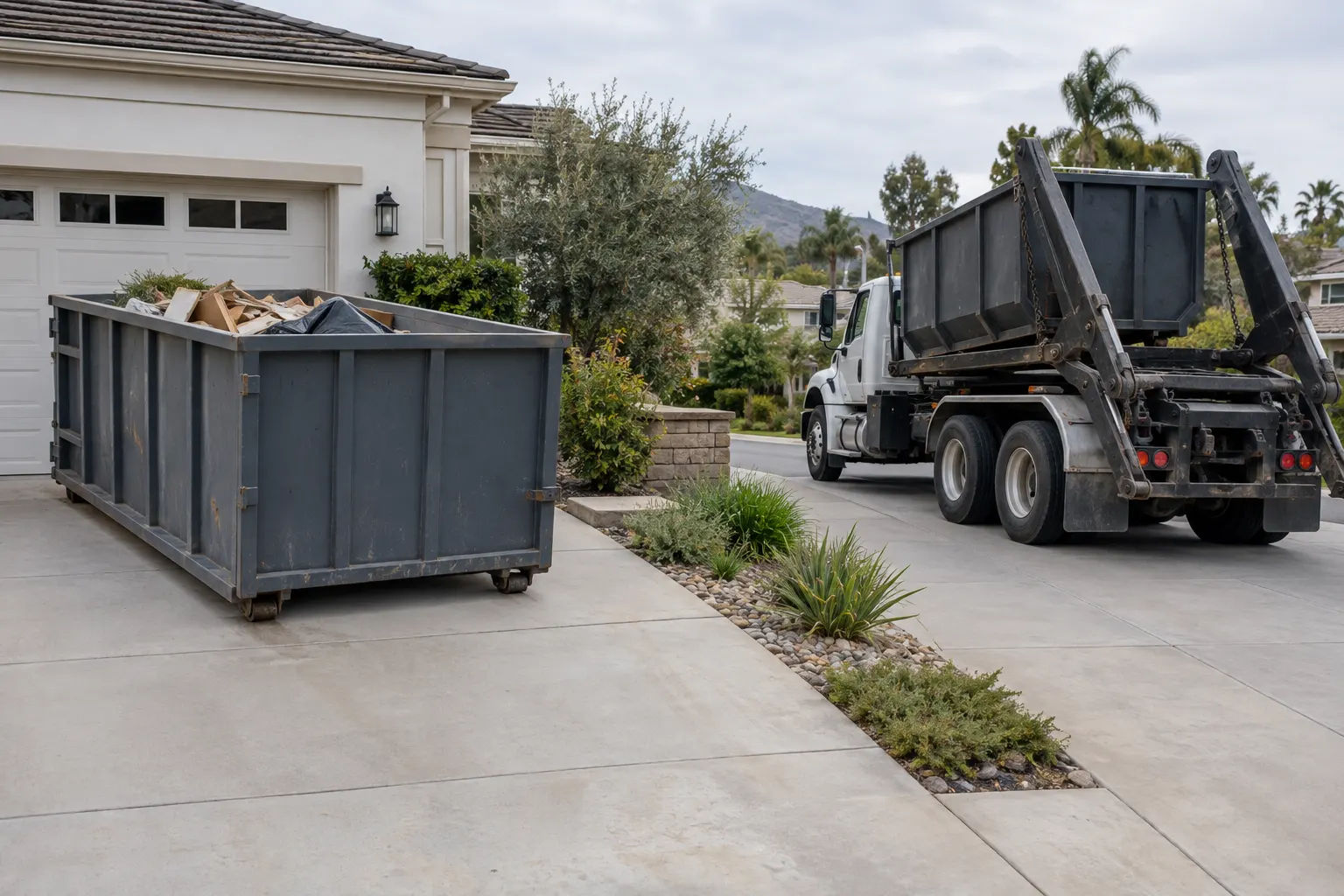
Use the work pattern to decide. A container supports a project that unfolds over days. Full-service hauling supports a defined pile that can be removed in one visit. Neither method is automatically cheaper or better without the load, labor, access, and timing details.
Side-by-side decision table
| Question | Dumpster rental may fit | Full-service removal may fit |
|---|---|---|
| Who loads? | You or your project crew | The hauling crew |
| How fast? | Material accumulates over several days | A prepared pile can leave in one appointment |
| How much? | A larger or changing volume of approved debris | A few bulky items or a clearly bounded pile |
| Placement | You have a suitable, approved container location | No long-term container space is available |
| Labor | You can safely carry and load the material | You need lifting and carrying help |
| Sorting | You want time to separate as the project develops | Sorting is already complete |
| Site impact | A container can remain without blocking access | The property needs to return to normal quickly |
Choose a residential dumpster when the project has a long middle
Flooring removal, a garage cleanout, move preparation, or a renovation can create debris in stages. A container lets the loading schedule follow the work instead of requiring every item to be ready at one appointment.
This option assumes that the property can accept the container and that someone can load it safely. You also take responsibility for keeping restricted items out, staying within fill and weight limits, and preventing neighbors or passersby from adding material.
Choose full-service removal when labor is the main problem
A hauling crew may be the clearer fit when the pile is already defined, items are inside the house, stairs are involved, or the customer cannot carry bulky pieces. It may also work better when a building, driveway, landlord, or local rule does not allow a container to remain on site.
Ask what labor, travel, loading time, stairs, disassembly, and cleanup are included. Do not assume every provider accepts every material.
Check public collection for eligible bulky items
City of Los Angeles residents may have another option for eligible items. LASAN’s bulky-item pickup page describes scheduled curbside collection for qualifying household items and lists exclusions. Check the current page for eligibility, preparation, timing, and the item list before paying for private capacity.
A split plan can be better than forcing one method
A renovation might send reusable cabinets to donation, hazardous products to a S.A.F.E. Center, eligible furniture to City bulky collection, dense tile to a dedicated debris container, and ordinary household cleanout material to another approved route. Separate streams can reduce confusion and prevent a rejected mixed load.
Questions for both providers
- Which materials are accepted, restricted, or charged separately?
- What labor, time, weight, rental period, or volume is included?
- What property access is required?
- Who handles permits or confirms that none are needed?
- What happens if the load is larger or heavier than described?
- What are the cancellation, failed-access, and rescheduling terms?
- How should electronics, appliances, mattresses, tires, and hazardous waste be handled?
A quick scorecard
Give one point to the method named after each true statement.
Dumpster rental
- The project creates debris over more than one day.
- You can load the material safely.
- You have an approved placement area.
- The load is larger than a few items.
Full-service removal
- You need lifting and carrying labor.
- The pile is ready now.
- A container cannot remain on the property.
- Fast return to normal use matters most.
A tie usually means the job needs two quotes built from the same written item list and access notes. Compare the included work, not only the headline price.
Los Angeles public-service source checked September 23, 2026. Municipal eligibility applies only where LASAN provides the stated service; verify the service address directly.
Think a container fits?
Measure the pile and placement area before calling so the comparison is based on the real job.
Use the sizing worksheet or contact ClearPath.