
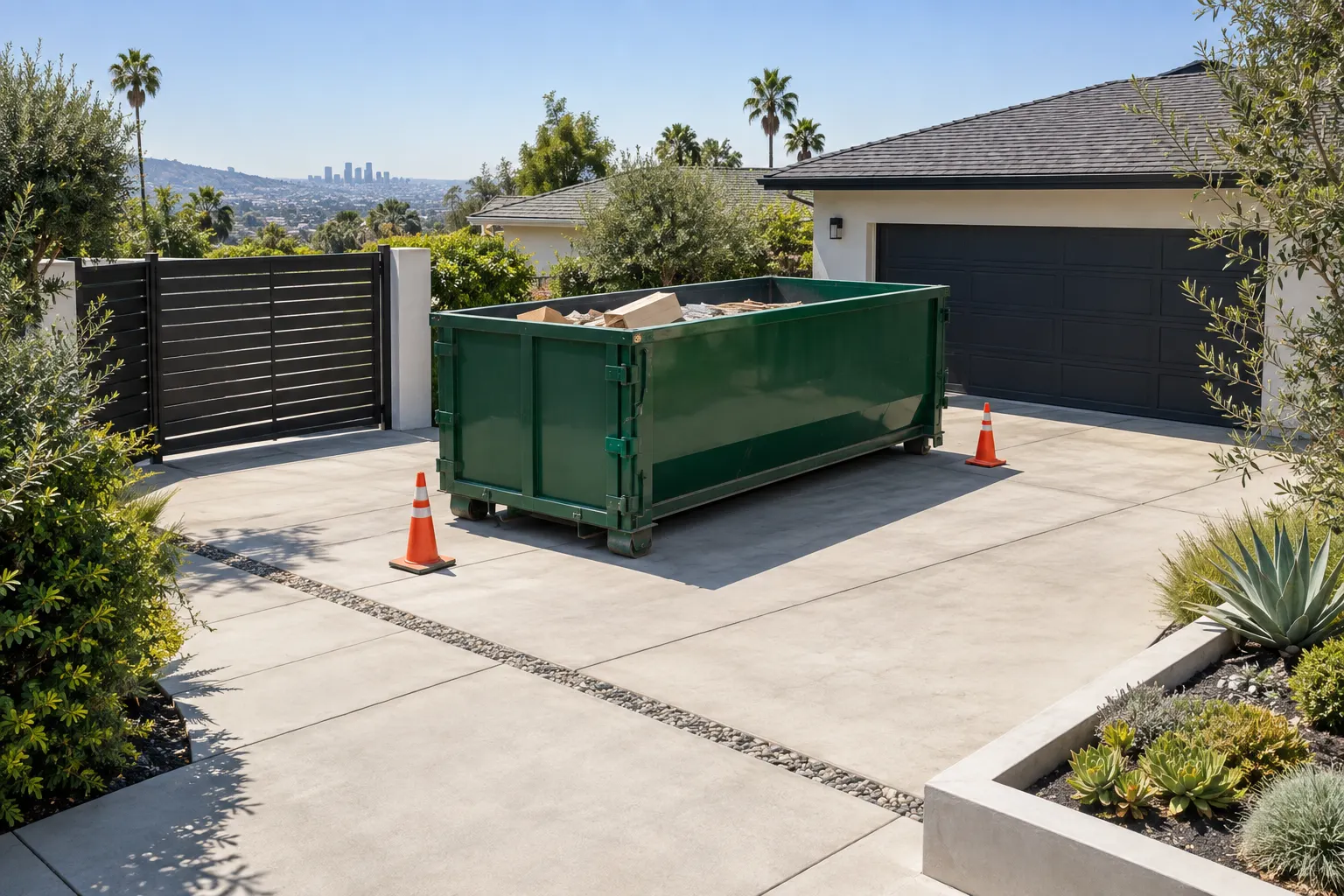
Start on private property. Look for a firm, reasonably level surface that the property owner approves and a delivery truck can reach without crossing landscaping, striking overhead obstacles, or blocking required access. If any part of the container or delivery operation would occupy a public street or right-of-way, verify current City requirements before scheduling.
Private-property placement checklist
- Measure the usable width and length of the placement area.
- Measure the narrowest gate, driveway, or alley opening on the approach.
- Look up for utility lines, tree limbs, awnings, balconies, and roof eaves.
- Note slopes, cracked paving, pavers, asphalt softened by heat, septic areas, and irrigation.
- Keep garage doors, building exits, sidewalks, fire access, and neighboring driveways clear.
- Confirm that the truck can enter, set the container, and leave without a tight turn.
Ask what surface protection the provider uses and what it can and cannot prevent. A heavy loaded container can stress paving. Do not promise the driver a spot that has not been checked.
Street and public-right-of-way placement
Los Angeles Municipal Code Section 62.61 states that, unless exempt, a person may not obstruct a public street or public right-of-way without the applicable permit from the responsible City bureau. Permit conditions can address traffic and public safety. Review the current rule with the City’s published code and contact the responsible agency for the exact location before delivery.
The Los Angeles Bureau of Engineering permit page explains that permits govern work and encroachments in the public right-of-way. A general website article cannot determine which permit applies to a particular address, street, duration, or traffic condition.
Measurements to send with the request
| Measurement | Why it matters | How to record it |
|---|---|---|
| Driveway width | Shows the narrowest approach | Measure edge to edge at the tightest point |
| Usable pad | Shows whether the container can sit fully on site | Record length and width, excluding doors and walkways |
| Overhead clearance | Delivery equipment needs vertical working room | Note the lowest wire, branch, eave, or awning |
| Slope | Affects safe placement and pickup | Send a wide side-view photo; do not estimate from memory |
| Turns | The truck needs room to align | Photograph the approach from the street |
Prepare the site on delivery day
- Move vehicles before the arrival window.
- Unlock gates and remove portable basketball hoops, bins, and other obstacles.
- Keep children and pets indoors while the truck is moving.
- Mark fragile paving, drains, irrigation heads, and property boundaries.
- Keep the placement decision-maker reachable by phone.
- Do not stand behind the truck or direct it unless the driver asks for a clear, safe signal.
Keep pickup access in mind
A container that was easy to deliver can become difficult to retrieve after vehicles, construction materials, or new piles surround it. Keep the approach clear throughout the rental. Load only to the stated fill line, keep material inside the walls, and follow the provider’s pickup instructions.
Questions to ask
- What are the container and truck dimensions?
- How much straight-line and overhead clearance is required?
- Does the proposed surface need protection?
- Who confirms municipal permit responsibility?
- What must remain clear for pickup?
- What happens if the driver cannot safely place the container?
Sources checked September 23, 2026. Geographic scope: City of Los Angeles. Municipal rules differ outside City boundaries, even when the mailing address says Los Angeles.
Send the placement details with the load list.
Wide photos and actual measurements make the first call more useful.
Open the direct contact information